VS10-C Vibration Sensor
Part Number: 10075
Product Overview
The VS10-C is a battery-powered wireless vibration sensor designed for field diagnostic measurements. Unlike the VS1, the VS10-C has no energy harvester — it is powered entirely by an internal rechargeable battery and charged via USB-C.
The VS10-C is operated using a single power button and mounts to equipment either magnetically or via threaded mounting holes. It communicates wirelessly over the 2.4 GHz spectrum and is designed to work with the TR1 (10064) and TR11-USB (10082) transceivers.
Package Contents
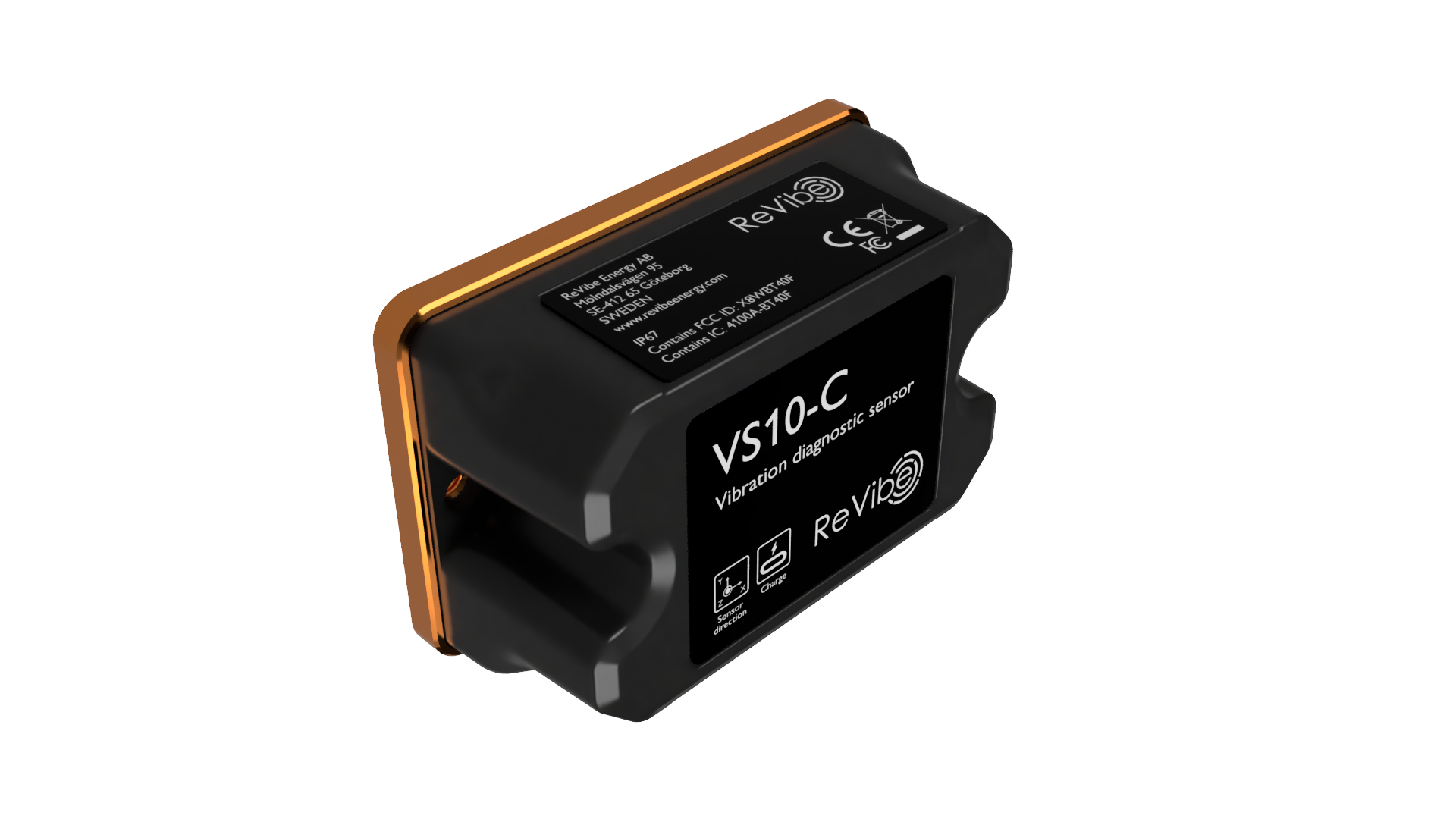
Part Number: 10075
Hardware Overview
Installation
The VS10-C attaches to the measurement target in two ways:
Temporary installation - Powerful neodymium magnets provide a strong yet removable attachment
Permanent installation - The unit can be attached using the 2× M6 threaded through-holes, 2× M5 screws, or affixed with suitable double-sided adhesive
Charging & Battery Life
The VS10-C charges via USB-C from a power bank or USB charger.
Charging is not allowed below -20 °C
Do not charge the device while in use
A full recharge from empty takes approximately 4 hours
While charging, the power button indicates state: Charging (blue), Charged (green)
The VS10-C has an operational battery life of up to ~120 hours before it automatically shuts down to prevent battery cell damage. The battery is rated for up to 5000 full recharge cycles.
Note
Battery voltage is monitored continuously. If it drops below approximately 2.95 V, the unit automatically shuts down to prevent over-discharge. A minimum of approximately 3.0 V is required to power the unit back on.
Settings
The VS10-C measures, collects, and transmits the following data, with user-configurable settings:
Raw Vibration Data
The VS10-C captures and transmits snippets of raw acceleration data (g) from the X, Y, and Z axes at user-defined sample rates and intervals.
Sample Rate - Selectable: 512, 1024, 2048, 4096, 8192, 16384 Hz (see AVSS Settings Reference for details)
Interval - How often the sensor records samples
Duration - The length of each sample
Aggregated Vibration Signal Metrics
In addition to raw snippets, the VS10-C continuously computes aggregated metrics from the acceleration signal. A high-pass filter first removes the DC component, after which the signal is integrated to derive velocity and displacement. Aggregated metrics—such as RMS, crest factor, peak, and FFT peak frequency—are then computed over a configured aggregation window.
Event-Triggered Waveform Capture
Note
This feature is experimental.
Waveform data can also be collected based on specific events (such as motion start) rather than on a time-based schedule. Captures can include pre-trigger data from a circular buffer to record conditions leading up to the event.
Health Monitoring
The VS10-C provides real-time status updates, including operational health and connectivity, at a user-defined interval (typically every minute). The health report includes:
Temperature (°C)
RSSI (dBm)
Battery Voltage (mV)
Uptime - time since last boot
Reboot Count and Reset Cause - useful for diagnosing unexpected restarts
Clock Synchronization Skew, Age, and Largest Offset - quality of the sensor’s time synchronization since the last report
Note
Depending on whether the VS10-C is used in a temporary measurement scenario (Vibreshark) or a permanent monitoring scenario (Base Hub), refer to the Base Hub manual or the settings section in the Vibreshark application.
Time Synchronization
While actively sampling, the VS10-C periodically synchronizes its internal clock to its designated time synchronization master, typically the transceiver or host application it is connected to. Time synchronization occurs immediately once the sensor starts sampling and is then repeated every 5 seconds. Full synchronization performance is achieved after two synchronization intervals.
The synchronized sensor clock enables precise, coordinated measurements across a network of sensors. All measurement timestamps use the synchronized time base, allowing data from different sensors to be accurately correlated in time.
Note
While sensor clocks are synchronized to within a few microseconds, the start timestamps of measurement windows from different sensors may differ by up to one sample interval (hundreds to thousands of microseconds). This is expected behavior—the system makes a best effort to align data measurement windows, but perfect alignment is not guaranteed.
ANURA Vibration Sensing Service
Like other ANURA sensors, the VS10-C communicates via AVSS (ANURA Vibration Sensing Service), a Bluetooth Low Energy GATT service that provides the interface for configuration, control, and data retrieval. AVSS enables the connected application to write configuration settings, trigger measurements, request data reports (snippets, aggregates, captures), and monitor sensor status.
See AVSS Settings Reference for a complete list of available settings and their descriptions.
Firmware Updates
The VS10-C supports over-the-air firmware upgrades using BLE, allowing users to update its firmware through the use of the Vibreshark application.
Product Care
- General use
Do not drop, throw, or subject the product to excessive force, as this could damage the plastic casing, aluminum plate, or internal components.
- Cleaning
Use a soft, damp cloth to gently clean the plastic casing and aluminum bottom plate. Avoid abrasive materials or harsh cleaning agents, as they may scratch the surfaces or damage the finish.
Specifications
Dimensions (excluding mounting accessories) |
90 × 60 × 38 mm |
Dimensions (w. 2× 32 mm pot magnets) |
90 × 60 × 46 mm |
Weight (w. 2× 32 mm pot magnets) |
290 g |
Power Supply |
Lithium-ion rechargeable battery, 1.32 Wh |
Radio Interface |
Bluetooth Low Energy (2.4 GHz) |
Antenna Gain |
typ. 6 dBi |
TX Power |
0 dBm |
RX Sensitivity |
-98 dBm |
Data Rate |
Up to 1 Mbps |
Frequency |
2.400 to 2.483 GHz |
Certifications |
CE, FCC |
Mounting |
2× M5 threaded holes (c/c 50 mm) for pot magnets |
Operating Temperature |
-40 °C to +80 °C |
Operating Humidity |
0% to 95% non-condensing |
Storage Temperature |
0 °C to +45 °C (-40 °F to +140 °F) |
Ingress Protection |
IP65 |
Enclosure Material |
Bottom plate: anodized aluminum alloy, orange |
Acceleration Measurement |
3-axis MEMS accelerometer (TDK InvenSense IIM-42352), ±16 g range |
Accelerometer Frequency Response |
XY-plane: DC to 4 kHz (±3 dB point) |
Temperature Sensor Accuracy |
typ. ±0.5 °C, -40 °C to 125 °C |
Edge Data Storage |
Non-persistent 64 Mbit QSPI PSRAM (AP Memory APS6404) |
Time Synchronization Offset |
typ. <5 µs |
Expected Product Lifetime |
|